Netflix fans love a good mystery, especially when that mystery comes with strange creatures, hidden secrets, emotional friendships, and a small community that feels normal on the surface but dangerous underneath. That is why The Boroughs vs Stranger Things has quickly become a hot comparison among viewers. On one side, you have Stranger Things, the massive Netflix sci-fi horror hit that turned Hawkins, Indiana into one of TV’s most famous fictional towns. On the other side, you have The Boroughs, a newer Netflix supernatural series that brings mystery, monsters, and unlikely heroes into a retirement community in the New Mexico desert.
At first glance, these shows may look very different. Stranger Things is built around kids, teens, families, government secrets, and the Upside Down. The Boroughs focuses on older residents, grief, time, memory, and a strange threat hiding beneath a peaceful retirement community. One show feels like a coming-of-age adventure wrapped in horror. The other feels like a late-life adventure wrapped in sci-fi mystery. Still, the connection between the two is hard to ignore.
The biggest reason is simple: the Duffer Brothers. Matt and Ross Duffer created Stranger Things and serve as executive producers on The Boroughs. That does not automatically mean the shows share the same universe, but it does explain why viewers feel a familiar rhythm. Both shows mix heart and horror. Both turn everyday people into heroes. Both use monsters as more than just scary creatures. And both understand that the best supernatural stories are really about people.
So, is The Boroughs connected to Stranger Things? The honest answer is: not in a confirmed shared-universe way. But creatively, emotionally, and structurally, the two shows share plenty of DNA. Let’s break down the 10 biggest things that connect them.
What Is The Boroughs About?
The Boroughs is a Netflix supernatural sci-fi series created by Jeffrey Addiss and Will Matthews. The story takes place in a seemingly peaceful retirement community in New Mexico. At first, the setting looks calm, sunny, and safe. But like many great mystery shows, the peaceful surface hides something much darker underneath.
The series follows a group of older residents who discover that their community is not as normal as it appears. A grieving newcomer becomes part of a misfit group of unlikely heroes, and together they begin uncovering a secret that threatens the one thing they do not have much of: time. That idea gives The Boroughs its emotional power. It is not just about surviving a monster. It is about what people do when they feel time slipping away.
The cast is also a major part of the show’s appeal. Alfred Molina, Geena Davis, Alfre Woodard, Denis O’Hare, Clarke Peters, and Bill Pullman bring experience, personality, and emotional depth to the story. Instead of treating older characters as background figures, The Boroughs puts them at the center of the adventure. That alone makes it stand out in the Netflix sci-fi space.
For fans of Stranger Things, the setup feels familiar but fresh. A strange community. A hidden threat. A team of outsiders. A monster mystery. Emotional wounds that matter as much as supernatural danger. The difference is that The Boroughs shifts the focus from childhood fear to aging, grief, and the fight to stay alive in more ways than one.
The Boroughs vs Stranger Things
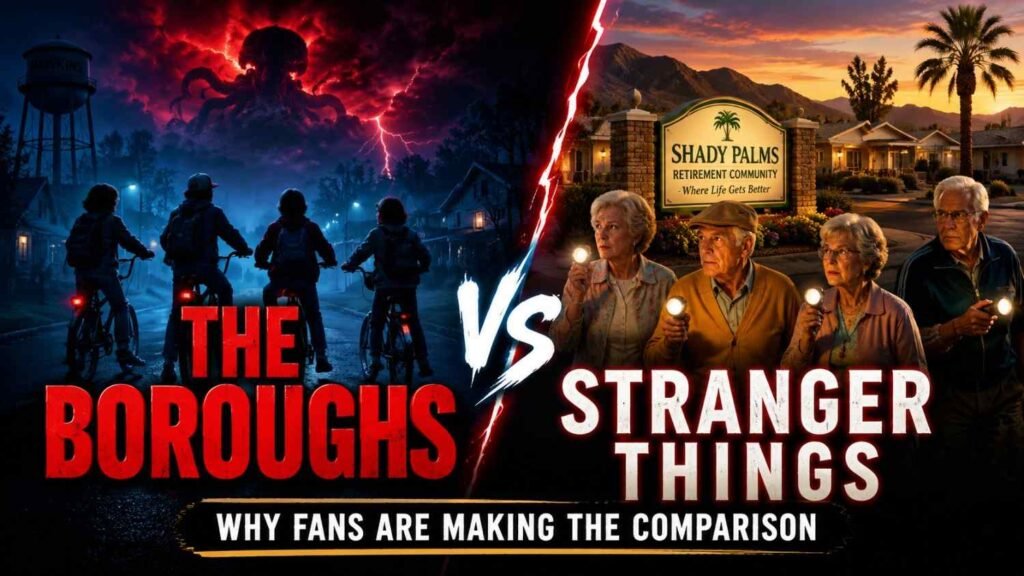
The Boroughs and Stranger Things are not officially confirmed as the same universe, but both shows share strong creative and story connections. From the Duffer Brothers’ involvement to supernatural mystery, small communities, and unlikely heroes, these two Netflix shows give fans a familiar but fresh viewing experience.
What Is Stranger Things About?
Stranger Things is one of Netflix’s most successful sci-fi horror series. Created by Matt and Ross Duffer, the show begins in Hawkins, Indiana, where a young boy named Will Byers disappears under mysterious circumstances. His friends, family, and local police chief begin searching for him, only to discover a terrifying alternate dimension known as the Upside Down.
What made Stranger Things connect with global audiences was not only its monsters or 1980s nostalgia. It was the way the show blended friendship, family, fear, government conspiracy, and growing up. The kids at the center of the story were brave, funny, messy, and loyal. The adults had their own emotional battles. The monsters were scary, but the human relationships gave the show its heart.
Over its run, Stranger Things expanded from a small-town mystery into a larger supernatural war. The Upside Down, Eleven’s powers, Vecna, the Mind Flayer, and the secrets behind Hawkins Lab turned the show into a layered mythology. But even as the stakes grew bigger, the emotional core stayed simple: people fighting for the ones they love.
This is where the comparison with The Boroughs becomes interesting. Both shows understand that viewers do not care about monsters just because they look frightening. Viewers care because the monsters threaten people they have grown attached to. That is the storytelling bridge between Hawkins and the New Mexico retirement community.
Are The Boroughs and Stranger Things Connected?
The Boroughs is not officially confirmed as a Stranger Things spin-off, sequel, prequel, or shared-universe story. There is no confirmed Upside Down crossover, no confirmed Hawkins connection, and no announced appearance by Stranger Things characters. So, if you are looking for a direct storyline connection, the answer is no.
But that does not mean the comparison is pointless. The shows are connected in a creative sense. The Duffer Brothers are executive producers on The Boroughs, and their style is clearly part of the discussion. The Boroughs also uses a similar blend of mystery, horror, humor, emotional characters, and a group of unlikely heroes facing something beyond normal explanation.
There is also a notable finale parallel that has made fans talk even more. Without turning this article into a full spoiler breakdown, The Boroughs uses a final unsettling moment that echoes the kind of “something is still wrong” ending Stranger Things used in its early storytelling. That does not prove a shared universe, but it does show a clear awareness of Stranger Things as a storytelling reference point.
The safest way to describe the relationship is this: The Boroughs is not Stranger Things 2.0, but it feels like a spiritual cousin. It takes some familiar ingredients and uses them in a new recipe. Instead of kids on bikes, we get retirees with life experience. Instead of Hawkins, we get a desert retirement community. Instead of the Upside Down, we get a different kind of supernatural threat tied to time, aging, and survival.
Connection One: The Duffer Brothers’ Creative Fingerprint
The most obvious connection between The Boroughs and Stranger Things is the involvement of the Duffer Brothers. Matt and Ross Duffer created Stranger Things, and they are executive producers on The Boroughs. That matters because executive producers can help shape tone, creative direction, production quality, and the overall feeling of a series.
The Boroughs was created by Jeffrey Addiss and Will Matthews, so it should not be treated as a show created by the Duffers themselves. Still, their involvement gives the series a strong link to the Stranger Things world of storytelling. You can feel that in the way The Boroughs balances emotional drama with strange horror. It does not treat the monster plot as separate from the characters’ lives. The supernatural threat grows out of the emotional world of the people facing it.
That is very similar to Stranger Things. In Stranger Things, the Upside Down is terrifying, but the show works because Will’s disappearance, Eleven’s trauma, Joyce’s desperation, Hopper’s grief, and the kids’ friendships make the story human. The Boroughs uses a different cast and setting, but it follows the same basic belief: horror lands harder when you care about the people in danger.
For readers searching “The Boroughs vs Stranger Things,” this is the first and strongest confirmed link. The shows are connected by creative influence, not by official shared-universe canon.
Connection Two: Small Communities With Big Secrets
Both shows understand the power of a small setting. Stranger Things has Hawkins, Indiana. The Boroughs has a retirement community in New Mexico. These places look ordinary at first, which makes the strange events feel even more disturbing.
Hawkins begins as a quiet town where kids play Dungeons & Dragons, families eat dinner, and people assume life is normal. Then a boy disappears, secret experiments come to light, and the town becomes the center of a supernatural nightmare. The Boroughs uses a similar contrast. A retirement community should feel calm, safe, and predictable. But the more the characters investigate, the more they realize danger has been hiding in plain sight.
This kind of setting works because it creates tension between comfort and fear. A monster in a haunted castle is expected. A monster under a normal neighborhood, school, lab, or retirement community feels more personal. It suggests that danger could be hiding behind any locked door or friendly smile.
Both shows also use community as a character. Hawkins is not just a location; it shapes the story. The same is true of The Boroughs. The retirement community is not just a backdrop. Its routines, residents, rules, and secrets all help build the mystery. That is one of the main reasons the two shows feel connected.
Connection Three: Ordinary Heroes Facing the Impossible
One of the best things about Stranger Things is that its heroes are not traditional action stars. They are kids, parents, teens, teachers, police officers, and regular people who are thrown into something impossible. The same idea appears in The Boroughs, but with a new twist.
The Boroughs makes older adults the heroes of the story. That is refreshing because many sci-fi and horror shows focus on young characters. Here, the central group has lived full lives. They have memories, regrets, losses, skills, and emotional scars. They are not blank slates. They bring decades of experience into the fight.
This creates a strong parallel with Stranger Things while also giving The Boroughs its own identity. In Stranger Things, the kids are underestimated because they are young. In The Boroughs, the retirees are underestimated because they are old. In both cases, the message is similar: people who are ignored by society may be exactly the people who notice what others miss.
That makes the hero group in The Boroughs feel like a clever mirror image of the Stranger Things kids. One group is coming into life. The other is looking back on life. But both groups are brave, loyal, curious, and willing to face danger together.
Connection Four: Monsters With Emotional Meaning
In weaker horror stories, monsters are just things that jump out and scare people. In stronger stories, monsters mean something. Stranger Things and The Boroughs both understand this.
In Stranger Things, the monsters are tied to trauma, fear, control, isolation, and the unknown. The Demogorgon is terrifying, but it also represents the first crack in Hawkins’ normal world. The Mind Flayer becomes a symbol of possession and loss of control. Vecna connects horror to memory, pain, and guilt. The monsters are not random. They reflect emotional and psychological danger.
The Boroughs also treats its supernatural threat as more than a creature feature. Its central ideas involve time, aging, grief, and the fear of losing what little time remains. That gives the monster story a deeper emotional layer. The threat is frightening not only because it can harm people, but because it attacks something deeply human: the desire to keep living, keep loving, and keep holding onto the people who matter.
This is one of the strongest creative connections between the two shows. Both use supernatural horror as a way to talk about real human fears. Stranger Things often explores the fear of growing up, losing friends, and facing trauma. The Boroughs explores the fear of aging, grief, and running out of time. Different life stages, same emotional strategy.
Connection Five: Mystery-Box Storytelling
Both shows use mystery-box storytelling, which means they slowly reveal answers while opening new questions. This style keeps fans watching, guessing, pausing scenes, reading theories, and debating clues online.
Stranger Things became famous for this. What happened to Will? Who is Eleven? What is the Upside Down? What is Hawkins Lab hiding? What does the Mind Flayer want? Who is Vecna really? Each season answered some questions while leaving enough mystery to pull viewers forward.
The Boroughs uses a similar engine. The show begins with strange events inside a retirement community and slowly builds toward a bigger supernatural truth. Viewers are invited to ask questions about the community, the threat, the people in control, and what the rules of this world really are.
The trick with this kind of storytelling is balance. Give away too much, and the mystery dies. Give away too little, and viewers get frustrated. Stranger Things usually kept fans hooked by tying every answer to character emotion. The Boroughs tries to do the same by connecting the mystery to grief, time, and the personal lives of its older heroes.
For SEO readers, this is an important point: The Boroughs is not popular only because of the Duffer name. It attracts attention because it gives mystery fans the same type of clue-hunting experience that made Stranger Things so addictive.
Connection Six: Heart, Horror, and Humor in One Package
The Duffer-style formula is not just horror. It is heart plus horror plus humor. Stranger Things could be scary one minute, emotional the next, and funny right after that. That tonal mix made the show feel alive.
The Boroughs follows a similar rhythm. It has danger and mystery, but it also has warmth. The characters joke, argue, bond, grieve, and support each other. This matters because pure darkness can become exhausting. Humor gives viewers breathing room. Emotion gives the horror meaning. Mystery gives the story forward motion.
Think of it like a three-legged table. Horror creates tension. Heart creates attachment. Humor creates balance. Remove one leg, and the whole thing becomes less stable. Stranger Things understood that from the beginning, and The Boroughs uses a similar balance for a different generation of characters.
This is especially important for a show about aging and grief. The Boroughs could have become too heavy if it only focused on loss. Instead, it gives its characters personality, wit, and group chemistry. That makes their adventure more fun to watch and more painful when danger arrives.
Connection Seven: Found Family Energy
Found family is one of the biggest emotional links between The Boroughs and Stranger Things. In Stranger Things, the main kids are not related by blood, but they act like a family. Eleven finds belonging with Mike, Dustin, Lucas, Will, Max, Hopper, and Joyce. Steve becomes an unexpected protector. The group keeps expanding, but the emotional idea stays the same: family is not always the people you are born with.
The Boroughs also builds around a group of people who come together through danger. These residents may not begin as best friends, but the mystery forces them to trust each other. As the threat grows, so does their bond. They become a team because survival depends on connection.
This theme works beautifully in both shows because supernatural danger makes loneliness more dangerous. No one can solve the mystery alone. No one can fight the monster alone. No one can carry grief alone. The group becomes the weapon.
For Stranger Things fans, this may be one of the easiest emotional bridges into The Boroughs. You are not just watching people investigate strange events. You are watching lonely, wounded, funny, stubborn people become necessary to each other.
Connection Eight: A Different Take on Age and Coming-of-Age
Stranger Things is a coming-of-age story. The kids grow up while facing monsters, trauma, friendship changes, first love, family struggles, and fear. The supernatural plot gives the show excitement, but the emotional journey is about growing older and losing innocence.
The Boroughs flips that idea. Instead of coming-of-age, it is almost a “coming-of-old-age” adventure. Its characters are not discovering childhood. They are facing the later chapters of life. That includes grief, regret, physical limits, memories, and the question of what still makes life meaningful.
This difference makes the shows feel connected and opposite at the same time. Stranger Things asks, “How do you grow up when the world is terrifying?” The Boroughs asks, “How do you keep living fully when time feels limited?” Both questions are powerful. Both are easy for viewers to understand. And both use supernatural danger to make those questions more urgent.
That is why The Boroughs does not feel like a copy of Stranger Things. It feels like a conversation with it. One show looks at youth through horror. The other looks at aging through horror. Together, they show how sci-fi mystery can speak to every stage of life.
Connection Nine: Finale Clues That Keep Fans Talking
Stranger Things knows how to end a season with fans asking questions. The Season 1 ending is a perfect example. The immediate danger seems reduced, but a final disturbing sign shows that the story is not really over. That kind of ending makes viewers feel both satisfied and unsettled.
The Boroughs uses a similar tactic. Its final moments leave viewers with fresh questions and a sense that the mystery may be bigger than what Season 1 fully explains. This kind of ending is not just a cheap cliffhanger when done well. It works because it suggests the characters have changed, the threat may not be fully gone, and the world has deeper rules still waiting to be discovered.
This is one of the strongest reasons fans compare The Boroughs vs Stranger Things. Both shows understand that a finale should close one door and quietly open another. Viewers want answers, but they also want that little chill that says, “Wait… what was that?”
Of course, there is a fine line here. A good mystery ending should feel intentional, not lazy. The Boroughs benefits from the fact that its creators have spoken about bigger story possibilities. That gives fans reason to believe the unanswered questions are part of a plan rather than loose ends thrown in for shock.
Connection Ten: Netflix’s Next Big Sci-Fi Mystery Lane
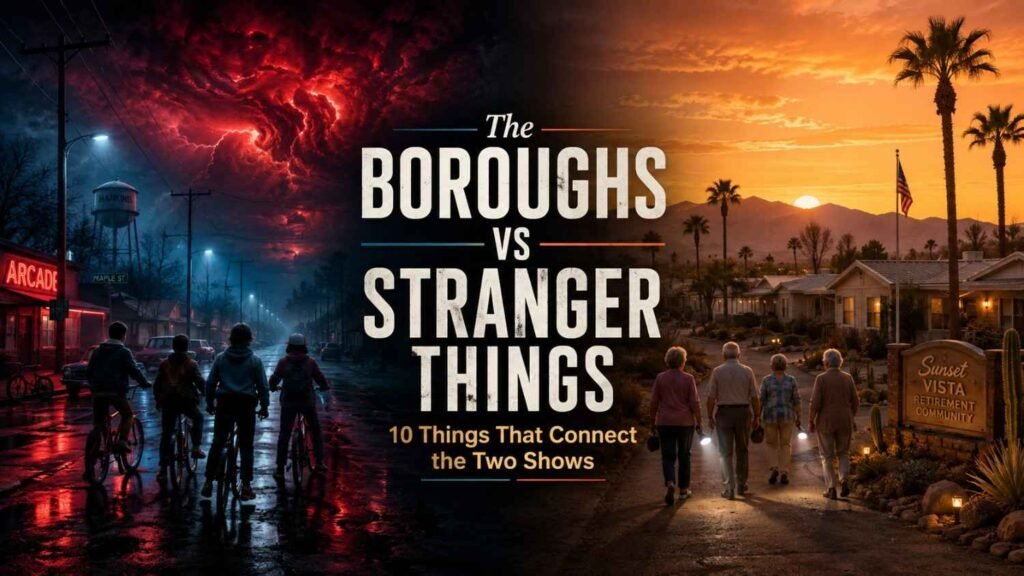
Now that Stranger Things has reached its final chapter, Netflix has a major challenge: what comes next for fans who love supernatural mystery? The Boroughs fits naturally into that conversation, even if it is not trying to replace Stranger Things.
No show can easily replace Stranger Things. It became a cultural event because of timing, cast chemistry, nostalgia, music, monsters, and years of audience investment. The Boroughs is different. It has a different age group, a different setting, and a different emotional theme. But it may appeal to viewers who want another Netflix mystery with strange events, lovable outsiders, and a hidden supernatural world.
This makes The Boroughs part of Netflix’s wider sci-fi mystery lane. It is the kind of show that can attract fans who enjoy theories, character groups, genre mixing, and emotional horror. It also gives older characters the kind of adventure usually given to teens or young adults, which helps it stand apart.
So, the connection is not “The Boroughs is the new Stranger Things.” A better way to say it is: The Boroughs may be one of the most natural next watches for Stranger Things fans who want a new mystery with a familiar creative heartbeat.
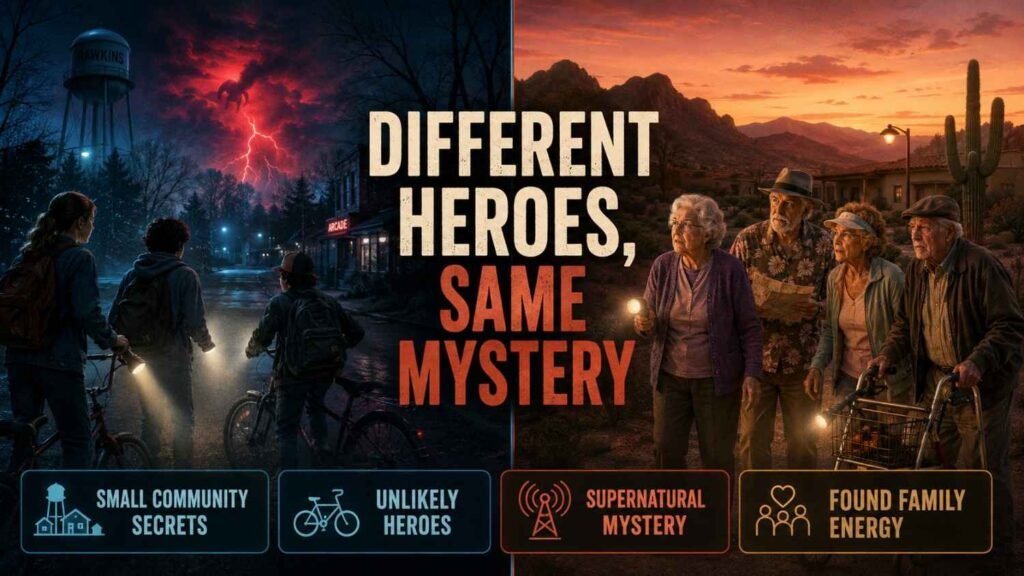
Different Shows, Similar Mystery Energy
The Boroughs and Stranger Things tell different stories, but both use mystery, emotional characters, and supernatural danger to keep Netflix viewers hooked.
Stranger Things
Stranger Things follows young heroes in Hawkins as they discover a dark supernatural threat connected to hidden experiments and another dimension.
- Small-town mystery in Hawkins
- Young heroes and emotional friendships
- Monsters, hidden worlds, and sci-fi horror
- Strong coming-of-age theme
The Boroughs
The Boroughs follows older residents in a retirement community as they face a strange threat that connects mystery, time, grief, and survival.
- Retirement community with hidden secrets
- Older unlikely heroes
- Supernatural mystery and emotional horror
- Strong themes of aging and time
The Boroughs vs Stranger Things Comparison Table
| Element | Stranger Things | The Boroughs | Connection |
| Main setting | Hawkins, Indiana | New Mexico retirement community | Both use ordinary communities hiding dark secrets. |
| Hero group | Kids, teens, parents, local adults | Older residents and unlikely retirees | Both focus on underestimated heroes. |
| Main genre | Sci-fi horror mystery | Supernatural sci-fi mystery | Both mix horror, emotion, and adventure. |
| Creative link | Created by the Duffer Brothers | Executive produced by the Duffer Brothers | Shared creative influence. |
| Emotional theme | Growing up, trauma, friendship, family | Aging, grief, time, second chances | Different life stages, similar emotional depth. |
| Monster role | Threats tied to the Upside Down and trauma | Threat tied to time, survival, and hidden secrets | Monsters carry symbolic meaning. |
| Tone | Scary, funny, emotional, nostalgic | Scary, emotional, witty, mysterious | Both balance heart and horror. |
| Fan appeal | Theories, clues, character bonds | Theories, clues, character bonds | Both invite discussion after episodes. |
This table shows why the comparison works. The Boroughs does not need to copy Stranger Things to feel connected. It shares a storytelling shape while building a different emotional world.
What Fans Should Watch Next
If you finished Stranger Things and are curious about The Boroughs, the best way to watch it is with the right expectations. Do not go in waiting for Eleven, Hawkins Lab, or the Upside Down. Go in expecting a new supernatural mystery with a different emotional center.
Here are a few practical viewing tips:
- Watch The Boroughs for character chemistry, not just monster answers.
- Pay attention to how the show uses time, memory, grief, and aging.
- Notice the way the retirement community functions like a mystery map.
- Compare the group dynamic with the Stranger Things kids, but do not expect the same tone.
- Treat any Stranger Things similarities as creative echoes unless Netflix confirms more.
Important Notes Before You Compare Both Shows
The biggest mistake fans can make is assuming every similarity means a secret crossover. Shared tone does not equal shared universe. The Duffer Brothers’ involvement does not automatically mean The Boroughs exists inside Stranger Things canon. Unless Netflix or the creators officially confirm a crossover, it is better to call the shows creatively connected rather than directly connected.
Another common mistake is expecting The Boroughs to move at the exact same pace as Stranger Things. Stranger Things begins with kids, a disappearance, and a high-energy mystery. The Boroughs has a different rhythm because its characters carry different life experiences. It may feel slower in some moments, but that slower pace helps the emotional themes breathe.
Fans should also avoid treating The Boroughs as just “Stranger Things with old people.” That description may sound catchy, but it undersells what the show is trying to do. The older cast is not a gimmick. Their age, memories, grief, and relationships are central to the story.
The better comparison is this: Stranger Things uses supernatural horror to explore childhood and growing up. The Boroughs uses supernatural horror to explore aging, time, and the fear of losing what remains. That makes the shows connected, but not identical.
The Boroughs vs. Stranger Things Final Verdict
The Boroughs and Stranger Things are not officially the same story, but they are connected in ways that matter to fans. The strongest connection is the Duffer Brothers’ creative involvement. After that, the links become more thematic: small communities with secrets, misfit hero groups, emotional monsters, mystery-box storytelling, found family, and finales designed to keep viewers thinking.
The Boroughs works best when viewed as a spiritual cousin to Stranger Things, not a replacement and not a confirmed spin-off. It carries some of the same genre energy but uses it for a different stage of life. Instead of kids discovering that the world is bigger and scarier than they imagined, The Boroughs follows older characters discovering that their story is not over yet.
That is a powerful idea. It gives Netflix fans a new mystery to follow while keeping enough familiar DNA to interest Stranger Things viewers. If you love stories where ordinary people face impossible things together, The Boroughs deserves a spot on your watchlist.
For anyone searching The Boroughs vs Stranger Things, the answer is clear: the shows are not officially connected by plot, but they are deeply connected by tone, creative influence, structure, and emotional storytelling.