
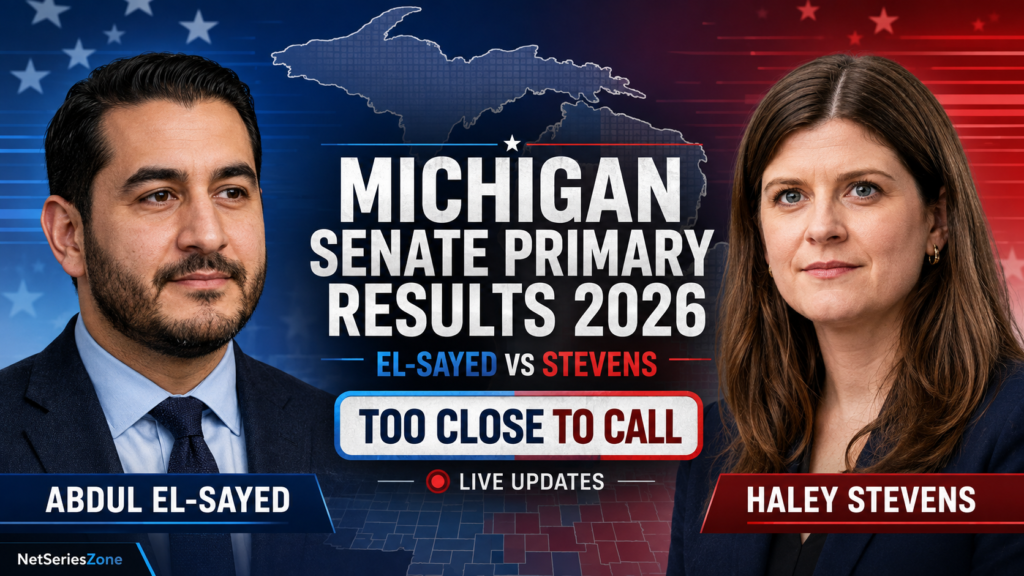
Race status: Too close to call
Abdul El-Sayed held a narrow lead over U.S. Rep. Haley Stevens early Wednesday in the Michigan Senate primary results 2026, but no official winner had been declared at the time of this update. Ballot counting was continuing, and remaining returns from Wayne County were among the most closely watched votes.
The winner of the Democratic nomination will advance to the November 3 general election against Republican Mike Rogers. The candidates are seeking the open U.S. Senate seat being vacated by retiring Democratic Sen. Gary Peters.
Michigan Senate Primary Results 2026 — Latest Update
The latest available reporting showed El-Sayed maintaining a small advantage over Stevens. One live count placed El-Sayed around 49% and Stevens around 47% with approximately four-fifths of the estimated vote reported. Because live election totals change as counties upload additional ballots, these percentages should be treated as a timestamped snapshot rather than final figures.
| Candidate | Party | Latest Reported Position | Race Status |
| Abdul El-Sayed | Democratic | Narrow lead, approximately 49% in one live tally | No winner declared |
| Haley Stevens | Democratic | Close second, approximately 47% in one live tally | No winner declared |
| Mike Rogers | Republican | Republican nominee | Advances to November |
Important: Check the Michigan Department of State results portal for the newest totals. Election-night and county figures are unofficial until the relevant canvassing boards complete certification.
Has the Michigan Senate Primary Winner Been Declared?
No. At this article’s stated update time, neither the Associated Press nor the official state election system had declared Abdul El-Sayed or Haley Stevens the winner.
A candidate can lead the public vote count without being declared the winner. Election organizations consider the size of the margin, where outstanding votes are located, how many ballots may remain and whether the trailing candidate still has a realistic mathematical path to victory.
The Associated Press says it only calls a race when the trailing candidates no longer have a realistic path to victory. Before the primary, AP identified Wayne County as especially important to the Democratic result and warned that a close race might take time to resolve.
Reported Results Are Not the Same as Certified Results
Three terms matter when reading election coverage:
- Reported result: A live total assembled from county or precinct reporting.
- Projected winner or race call: A news organization’s determination that one candidate cannot realistically be overtaken.
- Certified result: The official result approved after county and state canvassing procedures.
A race may be called before certification, but a candidate should not be described as the official winner when no reliable decision desk or election authority has made that determination.
Why Wayne County Matters
Wayne County includes Detroit and contains Michigan’s largest concentration of Democratic voters. Because a significant number of votes remained outstanding there as the statewide margin stayed narrow, its eventual totals could determine whether El-Sayed’s lead grows, shrinks or disappears. AP reporting specifically identified the outstanding Wayne County result as a central unresolved factor.
Other closely watched areas include:
- Oakland County: Stevens’ home region and an important suburban Democratic vote center.
- Washtenaw County: Home to Ann Arbor and a strong base for progressive voters.
- Kent County: A major West Michigan population center where both campaigns worked to build support.
- Genesee County: Includes Flint and provides another important measure of working-class Democratic support.
County analysis should be updated only when reliable, county-level totals become available. Avoid estimating county winners from incomplete statewide results.
Abdul El-Sayed vs. Haley Stevens
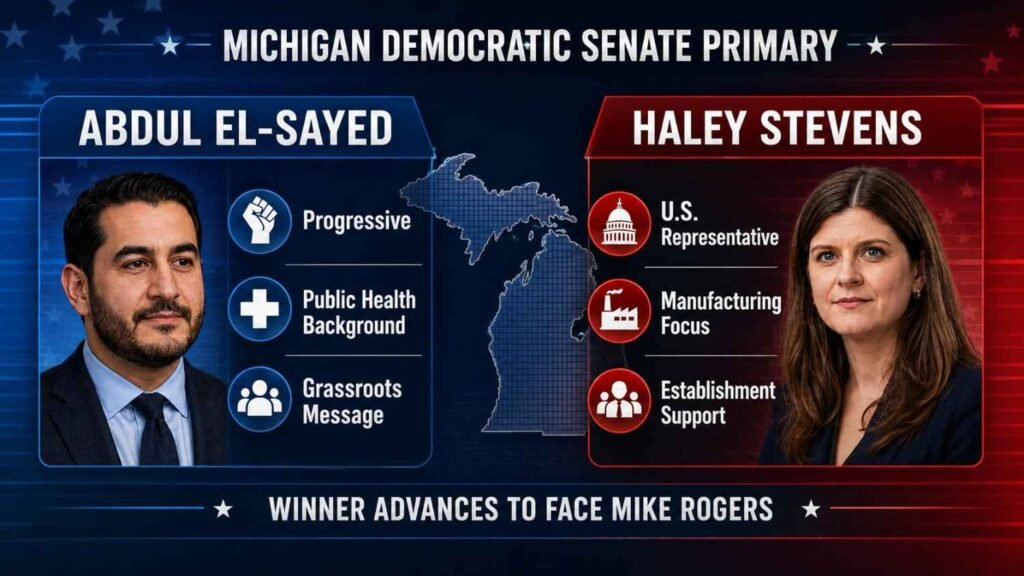
The contest became one of the most closely watched Democratic primaries of 2026 because it offered voters two different arguments about how the party should compete in a battleground state.
| Issue | Abdul El-Sayed | Haley Stevens |
| Political position | Progressive and anti-establishment | Moderate or establishment-aligned Democrat |
| Professional background | Physician, epidemiologist and former public-health official | Four-term U.S. representative |
| Campaign emphasis | Universal healthcare, cost of living and reducing big-money influence | Manufacturing, congressional experience and general-election electability |
| Prominent support | Bernie Sanders and progressive organizations | Chuck Schumer, Gary Peters and other party leaders |
| Outside-spending dynamic | Criticized major super-PAC and AIPAC spending | Benefited from large outside expenditures supporting her candidacy |
Reuters described the contest as a test of whether Democratic primary voters in a major swing state would support an anti-establishment economic-populist message or choose an experienced candidate backed by party leaders.
Who Is Abdul El-Sayed?
Abdul El-Sayed is a physician, epidemiologist and former public-health official who ran as the progressive candidate in the Democratic primary. His campaign emphasized universal healthcare, lower household costs, campaign-finance reform and a more critical approach to U.S. support for Israel.
El-Sayed received support from prominent progressive leaders, including Sen. Bernie Sanders. His campaign argued that an energized grassroots coalition could bring younger voters, Arab American voters, working-class residents and people dissatisfied with the Democratic establishment into the November electorate.
Who Is Haley Stevens?
Haley Stevens has served in the U.S. House since 2019 and represents a district based in Oakland County. Before entering Congress, she worked in the Obama administration’s auto-industry recovery effort. Her Senate campaign focused on manufacturing, legislative experience and the argument that a pragmatic Democrat would be better positioned to defeat Rogers.
Stevens gained endorsements from major Democratic figures, including Senate Democratic leader Chuck Schumer and retiring Sen. Gary Peters. Her supporters presented her congressional record and suburban appeal as evidence of general-election strength.
Get the Latest News, Election Results and Trending Stories
Visit NetSeriesZone for the latest U.S. political news, election coverage, explainers and trending updates.
Visit NetSeriesZoneThe Issues That Shaped the Michigan Democratic Primary
Although Israel and Gaza received significant national coverage, the candidates also competed over healthcare, household costs, manufacturing, President Donald Trump and the influence of wealthy political donors.
Healthcare and Economic Costs
El-Sayed made universal healthcare and medical costs central to his campaign. His broader economic message argued that government should focus more directly on working families and less on wealthy donors and corporations.
Stevens emphasized her congressional experience, manufacturing policy and her ability to deliver practical results. She also presented herself as a forceful opponent of the Trump administration.
Reuters reported that voters’ concerns about groceries, gas, rent and healthcare were expected to remain central after the primary, regardless of which Democrat won.
Electability Against Mike Rogers
A major argument throughout the race concerned electability.
Stevens’ campaign said her more moderate profile and experience winning competitive elections made her the safer nominee. El-Sayed’s campaign countered that enthusiasm, grassroots organizing and a clearer economic message could expand Democratic turnout.
A July WDIV/Detroit News survey found that 25.1% of likely Democratic primary voters considered beating Rogers the most important factor, while 38.2% prioritized selecting a candidate who would fight President Trump. The same survey showed Stevens ahead, but its margin of error and the eventual close count illustrated the limits of treating one poll as a prediction.
The Role of AIPAC and Outside Spending
Campaign spending became one of the defining stories of the primary.
The Associated Press reported that AIPAC and affiliated groups spent close to $30 million supporting Stevens, their largest investment in a single race at that point. El-Sayed repeatedly used the spending to argue that wealthy organizations and outside interests were attempting to shape Michigan’s choice.
Stevens said support for her reflected her record of working for Michigan and avoided making AIPAC the central subject of her campaign. The spending nevertheless helped transform the race into a national test of the organization’s influence and the Democratic Party’s divisions over Israel.
Outside spending does not appear as a vote on the ballot, but it can affect the volume of advertising, voter contact and negative messaging surrounding a candidate. Coverage should therefore distinguish between money spent directly by a campaign and independent expenditures made by outside groups.
Who Will Face Mike Rogers in November?
The eventual Democratic nominee will face Republican Mike Rogers in the November 3, 2026 general election.
Rogers previously represented Michigan in the U.S. House, served in the Michigan Senate and worked for the FBI. He was also the Republican nominee for Michigan’s other U.S. Senate seat in 2024, when he lost to Democrat Elissa Slotkin.
The general-election contest is expected to receive national attention because Michigan is a closely divided state and the seat is important to both parties’ plans for controlling the U.S. Senate. Reuters described the seat as critical to Democratic efforts to regain the chamber.
Add an internal link here using the anchor Mike Rogers Political Profile.
What Happens After the Michigan Primary?
The next steps are straightforward, even when the count is close:
- Local election officials continue processing and reporting eligible ballots.
- County canvassing boards review local results.
- The state completes the applicable canvassing and certification process.
- A final official result is published.
- The Democratic nominee begins the general-election campaign against Rogers.
The federal general election will be held on Tuesday, November 3, 2026.
A close final margin could also produce questions about recount eligibility or requests. Do not state that a recount will happen unless a candidate, election official or reliable news organization confirms it.
Important Notes When Following Live Election Results
Do Not Confuse a Lead With a Win
A two-point lead can look significant, but it may not be decisive when large groups of ballots remain unreported.
Check the Timestamp
Live-result pages can become outdated quickly. Every article update should display:
- Date and time
- Time zone
- Percentage of estimated vote reported
- Source of the numbers
- Whether the race has been called
Use Consistent Sources
Do not combine percentages from one news outlet with vote totals from another unless both use the same reporting feed and update time.
Update the Headline Carefully
Use:
El-Sayed leads Stevens; race too close to call
Do not use:
El-Sayed wins Michigan primary
unless a reputable decision desk or official authority has called the race.
Conclusion
The Michigan Democratic Senate primary remained unresolved early August 5, with Abdul El-Sayed holding a narrow lead over Haley Stevens. Outstanding ballots, especially in Wayne County, meant the trailing candidate still had a possible path, so declaring a winner would have been premature.
The final outcome will decide whether Democrats nominate a progressive outsider who campaigned against big-money politics or an experienced member of Congress supported by much of the party establishment. The winner will then face Republican Mike Rogers in one of the most closely watched Senate elections of 2026.
Bookmark this page and check back for updated vote totals, county results and the official winner announcement.
Frequently Asked Questions
Who won the Michigan Senate primary in 2026?
No winner had been declared at the stated update time. Abdul El-Sayed was narrowly leading Haley Stevens, but counting was continuing.
Did Abdul El-Sayed win the Michigan primary?
Not yet according to the latest verified status used for this article. He held the lead, but the race remained too close to call.
Is Abdul El-Sayed leading Haley Stevens?
Yes. Early Wednesday reporting showed El-Sayed ahead by a small margin, although the exact percentage varied as additional ballots were reported.
Why has the race not been called?
The margin is narrow, and enough outstanding ballots may remain to affect the result. Wayne County’s incomplete reporting was particularly important.
Are Michigan election-night results official?
No. Election-night totals are unofficial until the applicable county and state canvassing processes are completed.
Who is the Republican candidate for Michigan Senate?
Former U.S. Rep. Mike Rogers is the Republican nominee and will face the eventual Democratic nominee.
When is the Michigan Senate general election?
The federal general election is scheduled for Tuesday, November 3, 2026.
Where can I find official Michigan election results?
Use the election-results portal linked by the Michigan Department of State. County websites may also publish local totals, but those results remain unofficial until certification.