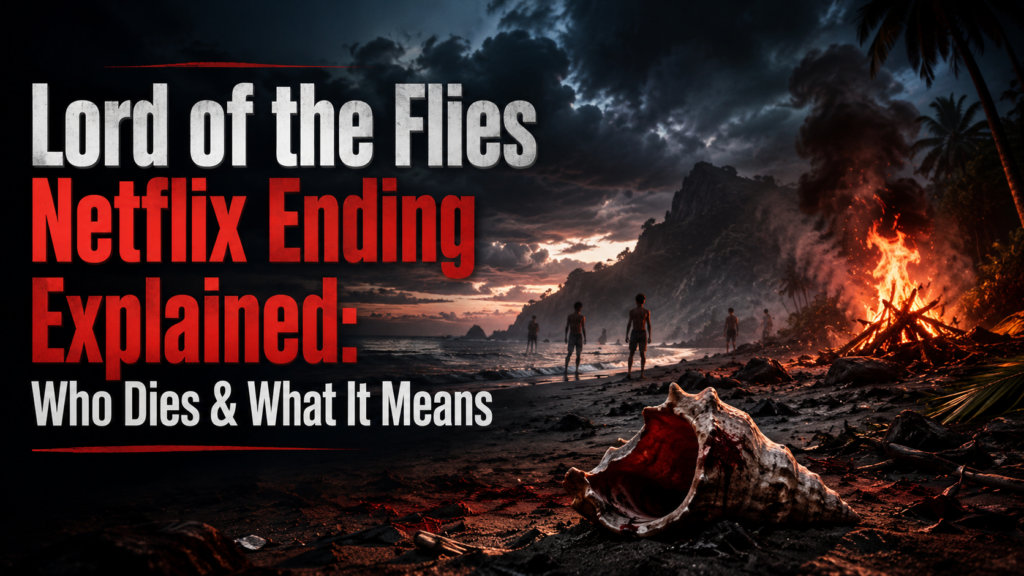
Netflix’s Lord of the Flies ending explained: who dies, how the finale ends, what it means, and the key differences from William Golding’s classic book. Full breakdown for viewers who just finished the 2026 limited series.
How Does the Netflix Series End?
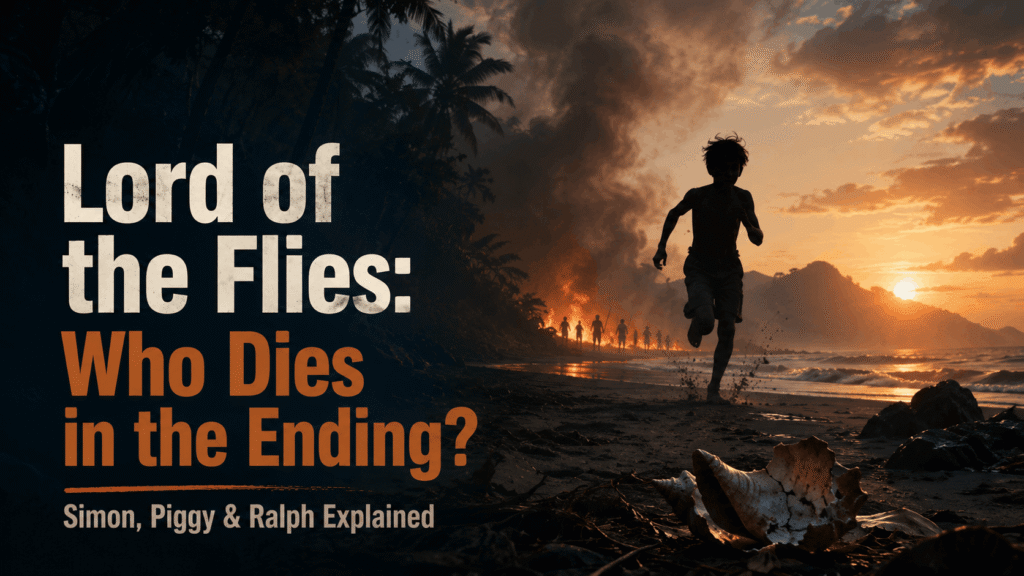
In the final episode of Netflix’s Lord of the Flies, Ralph is the last surviving member of his tribe after Simon is beaten to death and Piggy dies from a head wound. Jack’s savage hunters set the forest on fire to smoke Ralph out, but the smoke attracts a passing warship. A naval officer lands on the beach, rescues the boys, and is horrified when Ralph tells him two children died. The series ends with the survivors boarding the boat — their innocence destroyed, their fates after rescue left unknown.
Lord of the Flies Netflix Ending Explained: What Is the 2026 Lord of the Flies Netflix Series?
Lord of the Flies is the first-ever television adaptation of William Golding’s 1954 Nobel Prize-winning novel. The four-episode limited series arrived on Netflix in the United States on May 4, 2026, after premiering on BBC iPlayer in the UK on February 8, 2026. It’s a co-production between BBC One, Stan (Australia), and Sony Pictures Television, with Netflix holding exclusive U.S. rights.
The series was written by Jack Thorne — the Emmy-winning co-creator of Adolescence and writer of Enola Holmes — and directed by Marc Munden (Utopia, The Third Day). The score features music by Oscar-winning Hans Zimmer alongside Cristobal Tapia de Veer (The White Lotus).
Release Date and Where to Watch
- United States: Netflix — released May 4, 2026 (all 4 episodes)
- United Kingdom: BBC iPlayer — released February 8, 2026
- Australia: Stan — released February 8, 2026
- Other regions: Distributed by Sony Pictures Television to local broadcasters
The Creative Team Behind the Adaptation
Jack Thorne approached the adaptation with a specific modern lens. “As a society, we’re having a conversation right now about boys,” Thorne told Netflix Tudum. “We’re losing a generation of boys, and we’re losing it because of the hate they are ingesting — because it is an answer to their loneliness and isolation.”
Thorne saw Golding’s novel as “a difficult and dangerous account of who we are and what we’re capable of,” and aimed to bring that urgency to a new generation. The series was filmed on location in Malaysia, with the crew utilizing infrared cameras to capture day-for-night scenes, resulting in the jungle taking on an otherworldly pink and red glow.
Main Cast and Characters
The series features an ensemble of over 30 young actors, many making their professional debuts:
| Actor | Character | Role in the Story |
|---|---|---|
| Winston Sawyers | Ralph | The elected leader represents order and democracy |
| Lox Pratt | Jack | The head chorister who becomes the savage chief |
| David McKenna | Piggy | The intellectual outsider: Ralph’s closest ally |
| Ike Talbut | Simon | The sensitive, spiritual boy who “communes” with the island |
| Thomas Connor | Roger | Jack’s enforcer, who delights in violence |
| Noah & Cassius Flemyng | Sam & Eric | Twins who eventually join Jack’s tribe |
Notably, David McKenna (Piggy) is set to star as Digory in Greta Gerwig’s upcoming Netflix Chronicles of Narnia adaptation, and Lox Pratt (Jack) has been cast as Draco Malfoy in HBO’s Harry Potter series.
Episode-by-Episode Breakdown: The Road to the Finale
Each episode is titled after one of the four main characters and unfolds largely from that character’s perspective, with flashbacks revealing their lives before the crash.
Episode 1 — “Piggy”: The Crash and the Conch
The series begins with Piggy and Ralph meeting on a deserted island after a plane crash. They gather the survivors — all boys, no adults — and Ralph is elected chief over Jack, the head chorister. Jack styles his choir as hunters. Rumors of a “beast” on the island emerge among the younger boys. The group builds a signal fire at the island’s peak, but it’s too large and destroys part of the jungle.
Episode 2 — “Jack”: The Fire Goes Out
Jack becomes obsessed with killing a pig. His hunters succeed in their first kill, but they let the signal fire die while a ship passes on the horizon. Ralph blames Jack for costing them the rescue, and Jack retaliates by starting his own camp, splitting the group into two tribes. The fracture deepens.
Episode 3 — “Simon”: The Beast and the First Death
This is the most emotionally devastating episode. Jack steals Simon’s diary, which reveals the depth of Simon’s feelings for Jack — a significant addition not in the original novel. The two camps form an uneasy truce to search for the beast, but they’re terrified by a dead paratrooper caught in the trees.
Jack departs again, luring boys to his camp with promises of meat and freedom from rules. Simon slips away and communes with voices in the undergrowth — the loudest claiming to be the “Lord of the Flies” himself — who taunt and mock him until he flees in terror. As Jack’s party descends into animalistic chaos, his hunters seize upon Simon, beating the frenzied boy to death in a ritualistic murder.
Episode 4 — “Ralph”: The Hunt and the Rescue
The finale. Jack’s tribe steals Piggy’s glasses — their only means of making fire. Ralph and what’s left of his group approach Jack to demand them back. Roger, now fully embracing violence, throws a rock at Piggy’s head, mortally wounding him. Ralph escapes with Piggy and tries to care for him, but Piggy slowly bleeds out in the forest. Ralph buries him in a shallow grave. Flashbacks reveal Ralph recently lost his mother.
Sam and Eric, now forced into Jack’s tribe, secretly warn Ralph that Jack plans to hunt him down and kill him. Ralph confronts Jack one last time, telling him he wants no part of being chief over what the island has become. Roger proposes setting a fire to smoke Ralph out of hiding. The plan works — Ralph runs from the burning forest onto the beach, straight into the path of Jack’s hunters.
Lord of the Flies Netflix Ending Explained: The Finale Breakdown
Piggy’s Death: How It Differs From the Book
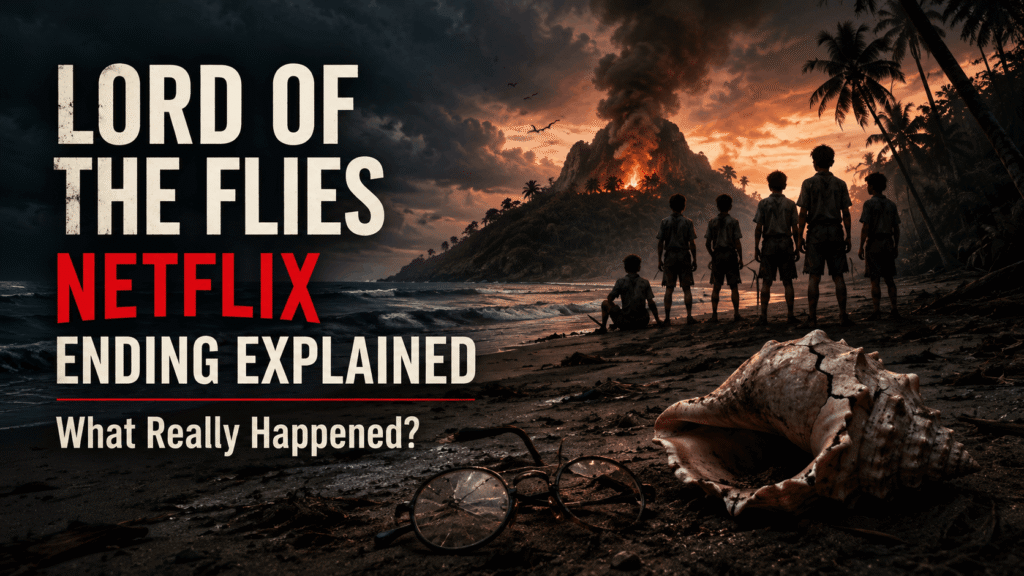
In William Golding’s novel, Piggy dies instantly when Roger pushes a boulder off a cliff, crushing him and shattering the conch shell. In the Netflix series, death is more intimate and prolonged. Roger throws a rock that strikes Piggy in the head. Ralph drags him into the forest and holds him as he slowly bleeds out. This change makes Ralph’s grief more visceral and gives their final moments together emotional weight that the book’s sudden death doesn’t provide.
Ralph’s Final Confrontation with Jack
Before the fire, Ralph finds Jack and tells him, “I don’t want to be chief. Not of this.” It’s a powerful moment because Ralph recognizes that leadership over savagery is meaningless. Jack stands silently — he’s won the tribe, but lost something essential. Their conflict was never just about power; it was about what kind of world they were willing to build.
The Naval Officer and the Rescue
As Ralph runs onto the beach, he sees a man standing by the water — and beyond him, a warship. The naval officer (played by Tom Goodman-Hill) has seen the smoke and come to investigate. Just as Jack’s hunters burst onto the beach with spears and painted faces, the officer witnesses the scene.
The Final Scene: What Ralph Tells the Officer
The officer, in classic British stiff-upper-lip fashion, initially treats the boys’ savagery like a game. “I would have thought you could put on a better show than that,” he says, expecting organized British children to have maintained order.
Ralph responds: “It was like that at first. Before things… we were together then.”
When the officer asks if there have been any casualties, Ralph nods and says, “Two.”
The officer’s amusement turns to shock. He does his best to soothe Ralph while reproaching the boys for their recklessness. The surviving children — including a silent Jack — drop their spears and follow the officer to the boat. The camera lingers on Ralph’s face as he leaves the island, a boy who has seen too much.
Who Dies in the Netflix Series? (Death Timeline)
| Character | Episode | Cause of Death | Book Comparison |
|---|---|---|---|
| Simon | Episode 3 — “Simon” | Beaten to death by Jack’s tribe during a frenzied ritual | Similar — killed by hunters during a storm |
| Piggy | Episode 4 — “Ralph” | Mortally wounded by a rock thrown by Roger; bleeds out in Ralph’s arms | Different — in the book, crushed instantly by a boulder |
The “boy with the birthmark” is implied to have died in the island fire in Episode 1, though this is less explicit than in the novel. No other named characters die on screen.
Lord of the Flies Netflix vs Book Ending: Key Differences
The series is largely faithful to Golding’s novel, but Thorne made several meaningful changes that deepen the emotional impact:
Piggy’s Death: Slow Bleed vs Instant Fall
As mentioned above, the biggest structural difference is Piggy’s death. The book’s sudden boulder death is cinematic but distant. The series’ version forces Ralph — and the audience — to sit with the consequences of the violence. It also removes the conch-shattering symbolism, replacing it with a quieter, more human tragedy.
Simon’s Diary and the Queer Subtext
This is the most significant addition. In the series, Jack steals Simon’s diary, which reveals Simon’s romantic feelings for Jack. This adds layers to their relationship: Simon isn’t just the “spiritual” boy — he’s a boy experiencing unrequited feelings for someone who ultimately leads his murderers. It makes Simon’s death even more heartbreaking and gives Jack’s cruelty a personal dimension.
Ralph’s Flashbacks to His Mother
The series includes flashbacks showing Ralph having recently lost his mother. This explains his desperate need to maintain order — he’s trying to rebuild the structure and safety he lost. It makes his breakdown at the end more poignant.
What Stays the Same
- The basic arc: crash → order → tribal split → savagery → rescue
- Simon’s death during a frenzied “beast” hunt
- The naval officer’s rescue and ironic chastisement
- The core symbolism: conch = democracy, fire = hope, painted faces = anonymity
- The final message: civilization is fragile, and darkness lives in everyone
What Does the Ending of Lord of the Flies Really Mean?
Civilization Is a Thin Veneer
The central message of both the book and the series is that the structures we call “civilization” — rules, democracy, politeness — are fragile constructions. Remove them, and the “beast” isn’t an external monster. It’s the capacity for violence that lives inside every person. The boys don’t become savages because the island makes them. They become savages because the island removes the consequences that keep their darker impulses in check.
The “British Boys” Irony
The naval officer’s comment about expecting better from “British boys” is the story’s sharpest irony. It exposes the colonial arrogance that assumes Western civilization has somehow evolved beyond primal violence. The boys’ Britishness — their uniforms, their choir training, their boarding school manners — didn’t protect them from barbarism. If anything, the rigid hierarchy of their school lives (choir boys vs. non-choir boys) gave Jack a ready-made power structure to exploit.
Jack Thorne’s Modern Message About Boyhood
Thorne didn’t just adapt a classic — he reframed it for 2026. His comment about “losing a generation of boys” connects the island’s savagery to modern radicalization. Jack’s tribe isn’t just a story about children going feral; it’s a warning about how isolation, anger, and the promise of belonging can draw vulnerable boys toward cruelty. In an era of online radicalization and youth alienation, the story feels less like historical fiction and more like a mirror.
Why We Don’t See What Happens Next
The series ends the moment the boys leave the island. We don’t see them reunited with parents, or facing legal consequences, or in therapy. That’s intentional. The story isn’t about the aftermath — it’s about the collapse. Golding and Thorne both want us to sit with the uncomfortable truth that these boys are capable of murder, not to give us the comfort of seeing them punished or redeemed. The open ending is the point.
Is the Netflix Series Worth Watching?
If you’re a fan of psychological survival dramas, absolutely. The series holds a 95% critics’ score on Rotten Tomatoes (though audience scores are more divided at 59%), and Metacritic assigns it 83/100, indicating “universal acclaim.”
Critics have praised the young cast’s performances — particularly David McKenna’s vulnerable Piggy and Lox Pratt’s chilling Jack — and Munden’s hallucinatory visual style. Some viewers find it slow or too faithful to the book, but as an adaptation, it’s considered one of the most respectful and visually striking versions of Golding’s story.
If you enjoyed Adolescence (also by Jack Thorne) or survival thrillers like Yellowjackets, this is worth your time. If you’re sensitive to child violence or animal cruelty, proceed with caution.
Looking for more Netflix series to stream? Check out our guide to the [Best Netflix Series to Watch in 2026] and [Trending Web Series to Watch This Month].