Netflix sci-fi in 2026 is not just about aliens, robots, time loops, and glowing portals. The top 10 Mind-Blowing Netflix Sci-Fi Series are using futuristic ideas to ask very human questions: What makes a person real? Can technology save us without controlling us? Would humanity unite if the universe threatened us?
That is why this list is not built only around explosions or visual effects. It focuses on Netflix sci-fi series that stay in your head after the credits roll, the kind of shows that make you pause the episode and stare at the wall for a minute.
The timing is perfect because Netflix’s sci-fi catalog has become deeper and more global. Netflix’s official sci-fi TV guide highlights major mind-bending shows like 3 Body Problem, Black Mirror, Stranger Things, Dark, Alice in Borderland, Lost in Space, and Love, Death & Robots, showing how broad the genre has become on the platform.
At the same time, 2026 viewers are watching sci-fi through a new lens because artificial intelligence, digital identity, climate anxiety, surveillance, and misinformation are no longer “future problems.” They are daily-life problems wearing normal clothes.
Top 10 Mind-Blowing Netflix Sci-Fi Series
Another reasonNetflix sci-fi feels bigger right now is that its biggest genre hits have become cultural events. Netflix’s all-time global English TV rankings list Stranger Things 4 at 140.7 million views and Stranger Things 5 at 133.8 million views in the first 91 days, making both seasons among Netflix’s most popular shows ever.
That matters because sci-fi is no longer niche. It is mainstream storytelling with the power to shape conversations around fear, hope, technology, love, death, and the strange little question we all secretly ask: What if reality is not as solid as we think?
Quick Comparison Table
| Rank | Netflix Sci-Fi Series | Best For | Main Idea That Changes Your Thinking |
|---|---|---|---|
| 1 | 3 Body Problem | Cosmic mystery fans | Humanity may not be the center of the universe |
| 2 | Black Mirror | Tech-thriller fans | Technology reflects human desire, not just innovation |
| 3 | Dark | Time-travel puzzle lovers | Free will may be more fragile than we believe |
| 4 | Stranger Things | Emotional sci-fi horror fans | Friendship can survive impossible darkness |
| 5 | Alice in Borderland | Survival-game fans | Life becomes clearer when death is close |
| 6 | Love, Death & Robots | Short-form sci-fi fans | Big ideas can hit hard in small stories |
| 7 | The OA | Spiritual mystery fans | Belief can be as powerful as proof |
| 8 | Altered Carbon | Cyberpunk fans | Immortality may destroy identity |
| 9 | Cyberpunk: Edgerunners | Anime and dystopia fans | A body upgrade cannot fix a broken system |
| 10 | PLUTO | Philosophical anime fans | Robots can expose humanity’s moral failures |
1. 3 Body Problem
3 Body Problem deserves the number one spot because it makes the universe feel terrifyingly large again. A lot of sci-fi shows give us aliens as monsters, invaders, or mysterious lights in the sky, but this series turns first contact into a slow psychological earthquake. The official Netflix description says the story follows five brilliant friends making “earth-shattering discoveries” as the laws of science unravel and an existential threat emerges. That is exactly the hook: what happens when the rules you trust suddenly stop working?
The show is adapted from Cixin Liu’s famous novel and built around one of the most uncomfortable ideas in science fiction: maybe humanity is not ready to be noticed. It stretches across continents and decades, mixing science, politics, trauma, mystery, and cosmic horror. Instead of asking, “Can humans defeat aliens?” it asks something colder: Would humans even agree on what survival means? That is where the series becomes more than entertainment. It turns civilization into a group project where half the class is panicking, half is lying, and one person is quietly pressing the wrong button.
In 2026, 3 Body Problem is even more relevant because Netflix confirmed that Season 2 production began in Budapest in November 2025, meaning the story is actively moving forward. For viewers searching for the best Netflix sci-fi series of 2026, this is one of the most important titles to start with because it combines prestige drama with giant philosophical stakes. If you like shows that make your brain feel like it has opened twenty browser tabs at once, this is your show.
Why It Changes the Way You Think
The real power of the 3 Body Problem is perspective. Most of us live inside small worries: bills, work, school, relationships, Wi-Fi speed, and what to eat tonight. Then this show comes along and says, “Cool, now imagine all of human history is just a tiny flicker in a cosmic forest.” That idea is unsettling, but it is also strangely freeing. It forces you to think about time differently, not as days and deadlines, but as centuries, civilizations, and species-level choices.
The series also makes science feel emotional. When physics starts breaking, it is not just a technical problem; it becomes a spiritual crisis. Scientists who built their lives on logic suddenly face a reality that refuses to behave. That is why the show feels so intense. It is not just about whether Earth can survive. It is about whether humans can handle truth when truth stops comforting them. 3 Body Problem is the kind of Netflix sci-fi series that makes you look at the night sky differently, and honestly, that is exactly what great science fiction should do.
Read More: Best Netflix Series to Watch in 2026 That Everyone Is Talking About
2. Black Mirror
Black Mirror is the sci-fi series you recommend to someone when you want them to become suspicious of their phone. Charlie Brooker’s anthology has always worked because it does not feel distant. The worlds look almost normal, the people behave almost normally, and then one small technological twist turns everything into a nightmare wearing a friendly user interface. Netflix says Black Mirror Season 7 is now streaming, with six new episodes, and Brooker described the season as having “a mix of genres and styles.”
What makes Black Mirror so powerful is that it rarely blames technology alone. The show understands that apps, screens, algorithms, memory devices, and artificial intelligence are not magic villains. They are mirrors. They reflect jealousy, loneliness, greed, grief, fame, control, and the very human hunger to be seen. That is why the title works so well. The “black mirror” is not only your locked phone screen; it is also the darker version of yourself staring back from the glass.
In 2026, Black Mirror feels less like a warning and more like weather. We are already living inside recommendation systems, deepfakes, AI-generated media, digital surveillance, subscription fatigue, and social platforms that turn attention into currency. So when the show imagines a future where healthcare, memory, celebrity, or identity becomes trapped inside technology, the result does not feel impossible. It feels like tomorrow morning with better lighting and worse customer service.
Why It Changes the Way You Think
The genius of Black Mirror is that it makes you ask, “Would I do the same thing?” That question is uncomfortable because the answer is often yes. If an app promised to protect your loved one, would you accept the hidden cost? If technology could preserve someone’s memory, would you let grief become a product? If your life became content, would you resist or secretly enjoy the attention? The show works because it traps viewers in moral gray zones instead of handing out easy lessons.
As a Netflix sci-fi anthology, it is also extremely easy to watch because every episode stands alone. You can jump into one story, get emotionally wrecked, and then pretend you are fine. But the ideas linger. Black Mirror changes the way you think because it makes normal technology feel loaded with consequences. After watching it, every “Accept Terms” button feels a little more dramatic.
3. Dark
Dark is one of the smartest time-travel shows ever made, and yes, it demands your full attention. This is not the kind of series you casually watch while scrolling social media. Netflix’s sci-fi guide describes it as a German series about a fictional small town, a generation-spanning conspiracy, four connected families, a missing child, a wormhole, and “a whole lot of time travel.” That description is accurate, but it still cannot prepare you for how deeply the show twists cause and effect.
What makes Dark mind-blowing is not just the time travel. Many shows use time travel like a cool machine. Dark uses it like a curse. Every decision echoes backward and forward. Every character is both victim and cause. Every family secret becomes a knot in a rope that stretches across generations. Watching it feels like standing inside a clock while the gears move around you.
The show changes the way you think about free will. We like to believe we are choosing our path, but Dark keeps asking whether choice is real if the outcome has already happened. That is heavy, but the series never becomes cold. Its emotional center is grief, guilt, love, and the desperate human desire to fix what cannot be fixed. In that sense, Dark is not only about time. It is about regret, and regret is the most human time machine of all.
4. Stranger Things
Stranger Things is still one of Netflix’s biggest sci-fi pillars because it combines horror, friendship, government secrets, alternate dimensions, and coming-of-age emotion in a way that feels instantly addictive. Netflix’s sci-fi guide describes the series as following kids in small-town Indiana whose lives change after a friend vanishes, leading them into supernatural beings, alternate dimensions, and government conspiracies. That setup sounds familiar now because the show became so famous, but the reason it worked is simple: the monsters are scary, but the friendships are the real engine.
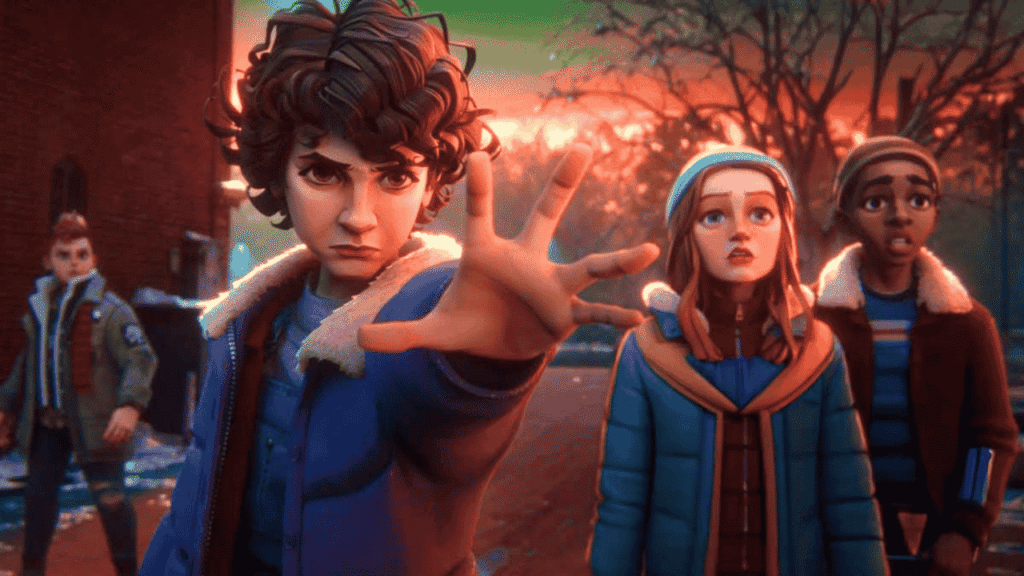
In 2026, the Stranger Things universe is especially active. Netflix’s Tudum page says Stranger Things 5 will be released in three parts, with four episodes on November 26, three episodes on Christmas, and the finale on New Year’s Eve. Netflix also launched Stranger Things: Tales From ’85, an animated series from showrunner Eric Robles and the Duffer Brothers, with all 10 episodes streaming as of April 23, 2026. That makes the franchise one of the most relevant sci-fi watches for 2026, whether you are revisiting the original or exploring the animated spin-off.
The reason Stranger Things changes your thinking is not that it has the most complicated science. It changes you because it reminds you that courage often looks messy. Kids argue, adults fail, plans break, monsters grow, and still someone grabs a flashlight and walks into the dark. That is powerful because real life works the same way. You rarely feel ready before facing something scary. You just go because someone you love needs you.
Why It Still Matters in 2026
Some shows fade after their big finale, but Stranger Things has become a modern myth. The Upside Down works because it turns childhood fear into a physical place. Every strange noise, every lonely hallway, every feeling of being misunderstood becomes part of a larger supernatural world. That is why the series connects across age groups. Adults see nostalgia, teens see friendship, and everyone sees the fear of losing people they love.
The 2026 animated expansion also proves that the world of Hawkins still has storytelling fuel. Tales From ’85 brings the characters into a new format while keeping the idea of strange mysteries alive. For a viewer looking for the top Netflix sci-fi series to watch right now, the original show remains essential because it is emotionally accessible, visually memorable, and culturally massive. It may not be the hardest sci-fi on this list, but it is one of the most human.
5. Alice in Borderland
Alice in Borderland is a survival thriller that turns Tokyo into a giant death-game puzzle, but its real obsession is not violence. It is valuable. What is a life worth when every decision can kill you? Netflix says the series follows Arisu, an aimless gamer trapped in a parallel Tokyo where he must compete in sadistic games to survive. The premise is instantly gripping, but the emotional impact comes from watching ordinary people discover who they become under pressure.
Season 3 made the show even more important for 2026 watchlists. Netflix’s Tudum update says Alice in Borderland Season 3 is out now, with Arisu and Usagi pulled back toward the Borderland and the Joker card becoming the final mystery. That is a big deal because it keeps the series fresh for anyone searching for a Netflix sci-fi thriller in 2026 or the best Japanese sci-fi series on Netflix.
The mind-blowing part of Alice in Borderland is how it uses games as philosophy. Every challenge reveals something about trust, sacrifice, intelligence, fear, or selfishness. Some games test the body, some test the mind, and some test whether you can keep your humanity when the rules reward cruelty. It is like watching a board game designed by someone who read too much existential philosophy and then decided everyone should run for their lives.
6. Love, Death & Robots
Love, Death & Robots is the wild card of Netflix sci-fi, and that is exactly why it belongs here. It is an animated anthology made of short stories, different visual styles, strange tones, and sharp ideas. Netflix’s sci-fi guide notes that the series was created by Tim Miller and executive produced by David Fincher, with episodes that run across genre and tone while centering on love, death, and robots. It is not one story; it is a sci-fi idea machine.
The best thing about Love, Death & Robots is that it respects your time while attacking your brain. Some episodes are funny, some are brutal, some are beautiful, and some feel like someone turned a nightmare into premium animation. Because many installments are short, the show can take big creative risks without needing to stretch every concept into eight hours. That makes it perfect for modern viewers who want something intense but not always long.
This series changes the way you think because it proves that sci-fi does not need one format. A 15-minute animated short can ask questions about evolution, war, consciousness, desire, or artificial intelligence as powerfully as a full season. In a world where streaming often rewards endless content, Love, Death & Robots feels like a box of strange, dangerous chocolates. You never know exactly what you are getting, but you know it will probably leave a mark.
7. The OA
The OA is not traditional sci-fi, and that is part of its magic. Netflix describes it as the story of a young woman who returns seven years after vanishing, now with mysterious abilities, and recruits five strangers for a secret mission. That sounds like a mystery drama, but the show slowly opens into questions about dimensions, death, belief, trauma, and whether storytelling itself can become a doorway.
This is the kind of series that divides people in the best possible way. Some viewers want clean answers, and The OA is not always interested in giving them. Instead, it asks you to sit with uncertainty. Is Prairie telling the truth? Are the impossible things literal, symbolic, spiritual, scientific, or all of the above? The show feels less like a machine and more like a dream you are trying to remember before it disappears.
What makes The OA mind-blowing is its emotional bravery. It treats belief as something dangerous but also beautiful. In most sci-fi, proof is king. Here, faith, performance, and shared vulnerability become part of the mystery. It changes the way you think because it asks whether reality only shifts when enough people are willing to imagine it differently. That may sound strange, but after a few episodes, you may find yourself leaning forward, waiting for the impossible to make sense.
8. Altered Carbon
Altered Carbon is cyberpunk with a sharp philosophical blade. Netflix describes it as the story of a prisoner who returns to life in a new body after 250 years, with one chance to win freedom by solving a mind-bending murder. The show’s central idea is simple but terrifying: human consciousness can be stored and moved from body to body. Death becomes optional, at least for the rich. And once death becomes optional, society becomes even more unfair.
The series changes the way you think about identity. If your memories move into a new body, are you still you? If the wealthy can keep buying new bodies, does power ever really die? If a body becomes a sleeve, what happens to dignity, intimacy, justice, and grief? Altered Carbon takes the dream of immortality and shows the bill hiding underneath it.
Visually, it is packed with neon streets, violence, luxury, corruption, and a cyberpunk atmosphere. But beneath the style, the show is about inequality. Technology does not automatically liberate everyone. Sometimes it just gives the powerful better tools to remain powerful. That is why Altered Carbon still feels relevant in 2026. As real-world technology pushes into AI, biotech, surveillance, and digital identity, this show asks a brutal question: What happens if the future arrives, but only the elite can afford it?
9. Cyberpunk: Edgerunners
Cyberpunk: Edgerunners is short, stylish, emotional, and absolutely devastating. Netflix describes it as an anime about a talented but reckless street kid trying to become a mercenary outlaw in a corrupt dystopia filled with cybernetic implants. That setup may sound like fast action, and yes, the action hits hard, but the real story is about poverty, ambition, body modification, and the cost of trying to outrun a system designed to crush you.
The show works because it understands that cyberpunk is not just neon lights and cool jackets. Real cyberpunk is about imbalance. Corporations have too much power. People sell pieces of themselves to survive. Technology looks glamorous until you realize it is another form of debt. David’s journey feels exciting at first because upgrades make him stronger, faster, and more dangerous. But the deeper he goes, the clearer it becomes that becoming powerful inside a broken machine does not mean you are free.
For 2026 audiences, Cyberpunk: Edgerunners feels especially sharp because we are surrounded by upgrade culture. Better devices, better bodies, better productivity, better personal brands — everything tells us to optimize. The series asks what happens when optimization becomes self-destruction. It changes the way you think because it turns “getting stronger” into a tragedy. Sometimes the system does not need to defeat you. It only needs to convince you to become useful to it.
10. PLUTO
PLUTO is one of the most thoughtful sci-fi anime series on Netflix. The official Netflix page describes it as a story where the world’s seven most advanced robots and their human allies are murdered one by one, leaving robot inspector Gesicht in danger as he investigates. On the surface, that sounds like a murder mystery. Underneath, it is a meditation on war, hatred, grief, memory, and what separates humans from machines.
What makes PLUTO special is its restraint. It does not rush to tell you what to feel. It lets silence, sadness, and suspicion build slowly. The robots are not treated like gadgets. They are treated like beings carrying emotional weight. That choice changes everything. Instead of asking whether robots can become human, the show asks whether humans are as morally advanced as they think they are.
In 2026, with AI becoming part of everyday conversation, PLUTO feels more relevant than ever. It pushes past the shallow question of whether machines can think and moves toward something harder: Can intelligence exist without hatred? The show is deeply political without feeling like a lecture, and it is emotional without becoming cheap. If you want a Netflix sci-fi series that feels mature, philosophical, and quietly heartbreaking, PLUTO is a must-watch.
Bonus Pick: The Eternaut
The Eternaut earns a bonus mention because it is one of Netflix’s strongest newer international sci-fi titles. Netflix describes it as a 2025 series about Juan Salvo and survivors in Buenos Aires resisting an invisible threat from another world after a devastating toxic snowfall kills millions. That image alone is unforgettable: snow, usually soft and beautiful, becomes deadly. It is a simple inversion, but it immediately makes the familiar world feel hostile.
The series stands out because it brings sci-fi disaster storytelling into a very specific cultural setting. Instead of another generic ruined city, we get Buenos Aires, community survival, fear, resistance, and invisible invasion. That gives the story texture. It reminds us that the end of the world would not feel the same everywhere. Every place would experience catastrophe through its own politics, relationships, memories, and streets.
The reason it changes the way you think is that it turns survival into solidarity. In many apocalyptic stories, people become isolated animals. The Eternaut is more interested in what people can do together when the environment itself becomes an enemy. It is a strong pick for viewers who want sci-fi with atmosphere, social tension, and a fresh global perspective.
Best Watch Order for New Sci-Fi Fans
If you are new to Netflix sci-fi, do not start with the most complicated show just because it is ranked high. Start with your mood. If you want something huge, emotional, and easy to enter, begin with Stranger Things. If you want a brain workout, go for Dark or 3 Body Problem. If you want short bursts of strange ideas, choose Love, Death & Robots. If you want technology paranoia, Black Mirror is the obvious first click.
For a powerful weekend binge, try this order: Black Mirror for the warning, 3 Body Problem for the cosmic scale, Alice in Borderland for adrenaline, PLUTO for emotion, and Dark when you are ready to fully surrender your brain. That order gives you variety without burning you out. Think of it like a sci-fi tasting menu: one dish is spicy, one is cold, one is sweet, and one makes you question the existence of the restaurant.
The best part is that these shows do not all do the same thing. Netflix sci-fi series in 2026 can mean anime, German time travel, Japanese survival horror, cyberpunk tragedy, philosophical robot mystery, tech satire, or cosmic invasion. That variety is exactly why the genre is so strong. Sci-fi is not one lane anymore. It is a whole city, and every street leads to a different version of the future.
FAQs
1. What is the best Netflix sci-fi series to watch in 2026?
The best overall pick is 3 Body Problem because it combines cosmic mystery, human drama, scientific fear, and long-term story potential. It is especially relevant in 2026 because Netflix confirmed Season 2 production began in late 2025. If you prefer tech horror, choose Black Mirror. If you prefer emotional adventure, choose Stranger Things.
2. Is Black Mirror still worth watching in 2026?
Yes, Black Mirror is absolutely worth watching in 2026 because its themes have become even more relevant. Season 7 is streaming on Netflix, and the show continues exploring technology, identity, memory, media, and moral consequences. It is one of the easiest sci-fi shows to start because every episode tells a separate story.
3. Which Netflix sci-fi series is the most confusing?
Dark is probably the most confusing in the best way. Its time-travel structure, family connections, and cause-and-effect loops require serious attention. If you enjoy complex puzzles, it is one of the most rewarding shows on Netflix. If you want something easier, start with Stranger Things or Alice in Borderland first.
4. What is the best Netflix sci-fi anime?
The best Netflix sci-fi anime depends on your taste. PLUTO is the strongest choice for philosophical storytelling, war themes, and emotional mystery. Cyberpunk: Edgerunners is better if you want fast action, dystopian tragedy, and stylish visuals. Both are excellent, but PLUTO is more reflective, while Cyberpunk: Edgerunners is more explosive.
5. Are these Netflix sci-fi series available everywhere?
Netflix availability can vary by country because licensing and regional catalogs change. However, many titles on this list are Netflix originals or official Netflix-featured titles, including 3 Body Problem, Black Mirror, Stranger Things, Alice in Borderland, The OA, Altered Carbon, Cyberpunk: Edgerunners, and PLUTO. Always check your local Netflix app for the most accurate availability.